And above all, the number of meals or parcels distributed does not, on its own, measure the scale of the needs.
in its quantitative study published in February 2026, the Federation of Social Services (FdSS)estimates that nearly 561,000 people receive food aid at least once a year in Belgium. This figure has doubled in ten years and is considered by the FdSS itself to be a cautious estimate, since it does not take into account informal aid or people who do not seek help even though they could be entitled to it.
More recently, a survey carried out by the Food Aid Coordination Platform between April and May 2026 reports a particularly worrying situation: requests continue to increase, while supplies are falling sharply. Many organisations are at saturation point or close to it, and nearly half of the organisations surveyed say they have had to reduce the quantities distributed or draw on their financial reserves to continue their activities.
Distributing less therefore does not necessarily mean that fewer people need help. It may also reflect a response capacity that is reaching its limits.
Another development is fuelling our concerns today: the consequences of the reform of unemployment insurance.
Since 1 March 2026, the new regulations have limited entitlement to full unemployment benefits to a maximum of 24 months, depending on work history, and insertion benefits to one year, as the ONEM [National Employment Office] specifies. For people already receiving benefits before the reform, entitlements are ending progressively, in waves.
The first figures now allow us to measure part of the consequences.
According to data from the SPP [Public Programming Service] for Social Integration, between January and June 2026, 99,144 people reached the end of their entitlement to unemployment or insertion benefits in Belgium. Among them, 43,613 accessed the social‑integration income. The SPP SI therefore estimates the transfer rate to CPAS [Public Centre for Social Welfare] at 44 % for this period. In Wallonia, this rate reaches 48.6 %.
These figures must be interpreted with caution: not all people excluded from unemployment will, of course, end up at a Resto du Cœur.
But certain signals are already visible. In its field survey published this summer, the FdSS notes that the new groups seeking food aid include newcomers who are excluded from unemployment benefits, sometimes after several months without income, but also of workers.
For the Restos du Cœur, the fear is therefore very real: that some of the people who are now turning to CPAS will tomorrow also need food aid.
This development comes at the very moment when the food‑aid sector has fewer means to respond.
In 2026, federal public funding dedicated to food aid fell from around €27 million to €15 million. The FdSS notes at the same time a sharp decrease in supplies, linked to this reduction in funding but also to the dwindling availability of unsold goods for the sector.
It is this scissor effect that is worrying: requests that remain extremely high, new groups appearing, and, on the other side, resources that are decreasing.
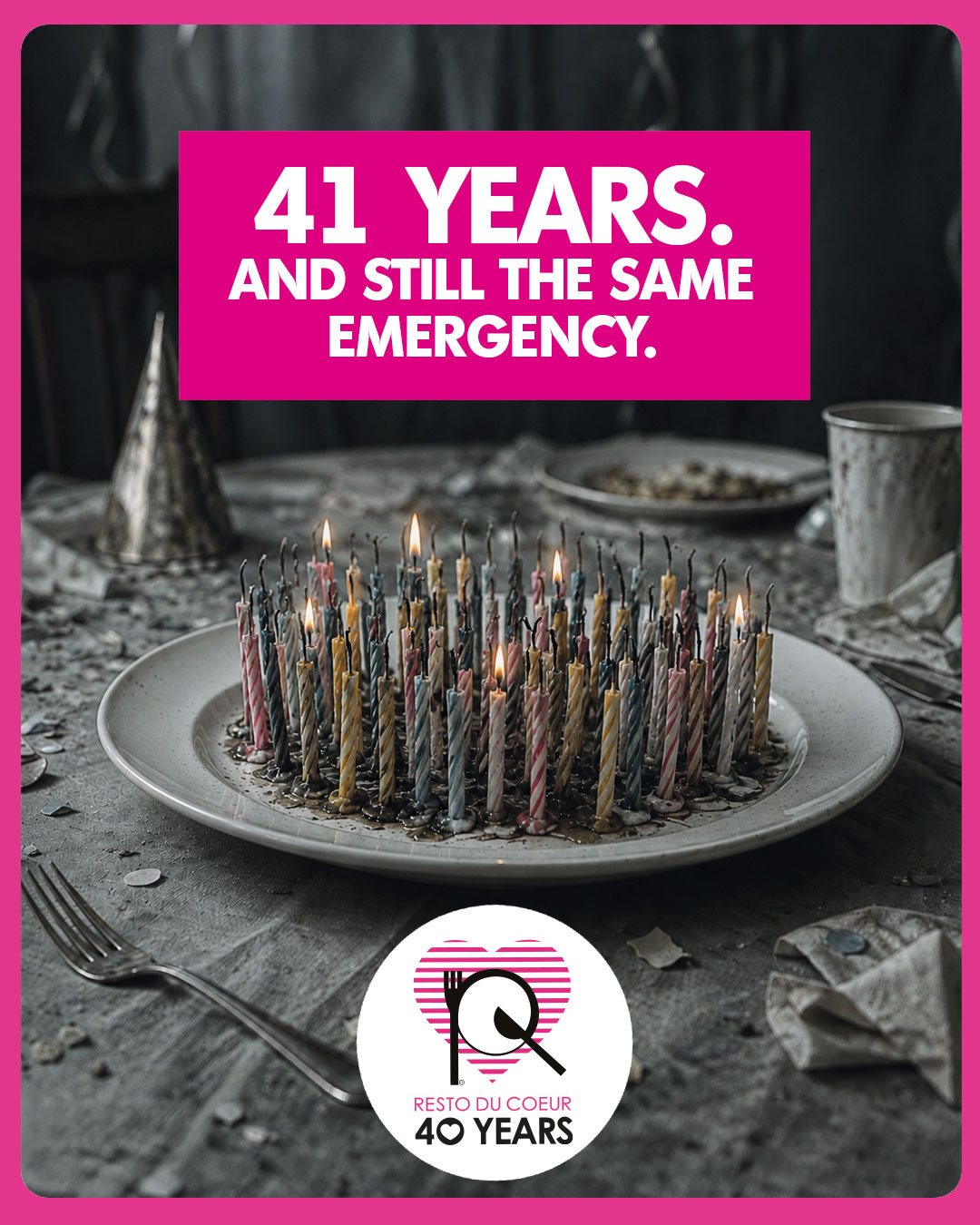
Forty‑one years after Coluche’s appeal, food aid has unfortunately still not become unnecessary. On the contrary, it must face a social reality that has become more complex and resources that are increasingly constrained.
The fact that the Restos du Cœur still exist today means two things.
First, it demonstrates an extraordinary chain of solidarity, carried for more than four decades by volunteers, employees, donors, partners and citizens who refuse to look away.
But it also reminds us that the struggle that motivated Coluche’s appeal is far from over.
We would have preferred no longer to have to relay this appeal.
In 2026, however, it remains painfully relevant.
As long as people need help to feed themselves and regain a measure of stability and dignity, the Restos du Cœur will continue to be there.